


Healthy Eating While Traveling: The Complete Nutrition Guide
I once stayed somewhere with no kitchen and no refrigerator. I filled the garbage can with ice and kept my food in it for the week.
That is the whole philosophy in one image. Healthy eating while traveling is not about finding ideal conditions, because you almost never get them. It is about being pragmatic and resourceful with whatever the trip actually gives you. Pack real food before you fly. Book a place with a kitchen when you can and a fridge at minimum. Hit a grocery store on arrival. Learn one ordering script for restaurants. There is never a situation where you cannot make something work, and I have spent enough years on the road to be confident saying that.
I spent about 15 years coaching people on nutrition before this became something I only do for myself. What follows is what I actually do, not what sounds good on a page.
The principle: pragmatic and resourceful
Every tactic below comes out of the same idea. You are not trying to eat perfectly on the road. You are trying to find the better option available in the situation you are actually in, and there is always one.
No kitchen? Rotisserie chicken and groceries brought back to the room. No fridge? Ice in whatever container the room provides. Only restaurants? Order extra and cover tomorrow. Airport with nothing good? You packed something.
None of this is complicated. It is just decided in advance rather than improvised while hungry.
Before you leave: what to pack
The single highest-return thing you can do is pack food before a long travel day.
Real sandwiches. I make them with actual chicken breast. A sandwich and a side salad in the bag and the flight is handled.
Skip the prepackaged deli meats. They are not a good protein source and they are not doing what people think they are doing.
Protein bars with short ingredient lists. I use RISE bars, which run three to five ingredients. That is the criterion I would give anyone: turn the bar over and count. If the list is long, it is a candy bar with a protein claim on the front.
Single serving nut packets. Portion control is built in and they survive a bag.
Protein powder. Comes on every trip.
Dried fruit. I buy it in bulk at Costco and portion it into smaller bags before I leave. Cheaper than single serve and I control the portions.
A collapsible cooler bag. This one surprises people. I bring it even when it is empty, because insulation is the thing you cannot improvise once you need it. If a grocery run or a batch of leftovers happens, I am ready. If not, it weighed nothing.
Where you stay decides most of it
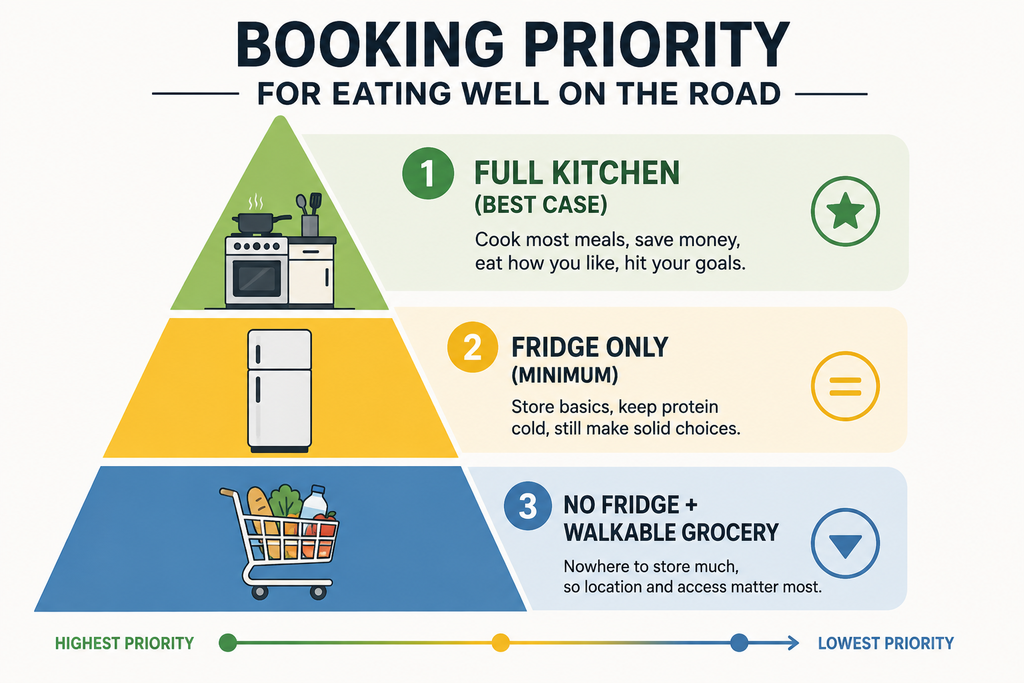
More of your nutrition outcome is determined at booking than at any meal.
A kitchen is the best case. I book Airbnb or VRBO specifically for this when the trip allows. Cooking your own food removes almost every problem this article addresses.
A fridge is the minimum. You can do a great deal with a fridge and no stove. Rotisserie chicken, yogurt, fruit, prepared salads, leftovers.
Grocery proximity matters if you will not have a car. When I know I am carless, I try to book within walking distance of a store. It does not need to be a good store. A Trader Joe’s or an Aldi is great, but a Target or a Walmart does the job.
No walkable store and no car? Grocery delivery. It exists nearly everywhere now and it costs less than a week of restaurant meals.
Cities make all of this easy. Outside cities it takes more due diligence before you book, which is exactly when people skip the step and then blame the location.
The grocery run
Land, drop bags, go to the store. Twenty minutes.
Rotisserie chicken is the workhorse. Is it perfect? No. Is it dramatically better than eating out for every meal? Yes, and that comparison is the one that matters. One bird covers several meals.
Fresh fruit and vegetables, or a prepared salad you can put the chicken on top of.
Greek yogurt cups. I use Chobani Pro-20. At Costco it runs about $18 for sixteen, though that moves around. Single serve cups mean no portioning and no spoilage.
Granola with clean ingredients. I use Simply Elizabeth. Honey and nut butter are useful too, in single serve where you can find it.
That is a shopping list you can execute in any store in the country without thinking about it.
How to order at a restaurant
The rule depends on your goal, and I want to be straight about that rather than pretend there is one answer.
If you are actively leaning out or holding lean, order strictly. Here is the exact script:
“Can you ask the chef to prepare it with no butter or oil?”
That is it. It is not a big ask, nobody is bothered by it, and it works almost everywhere. Steakhouses are especially good about it. Most restaurants are.
Then build the plate: a lean protein, chicken or steak. Steamed vegetables. Rice is generally fine. A baked potato where you control what goes on it. Avoid fried.
If you are gaining, the rules loosen but the floor does not. I am currently in a clean bulking phase, adding as much muscle as I can with as little fat as possible, accepting that some fat comes with it. Even then I am not eating fried food and junk. The goal changed. The standard did not.
Cuisines that make this easy:
- Steakhouses. Protein and vegetables, prepared how you ask.
- Mediterranean. Extra virgin olive oil rather than butter and seed oils, and skewered meats make it simple to eat clean without negotiating.
- Build-your-own bowl places. Qdoba, Cava, and similar. Salad base if you are leaning out, rice bowl if you need the fuel. Chipotle belongs on this list, though I personally avoid it, having gotten sick there more than once.
And order extra. This is underused. I have walked into a kebab shop and ordered enough for the next two days, then kept it in the cooler bag or just as cool as I could manage. Almost every city has one of these places, whether it is Greek, Turkish, Middle Eastern, Indian, or Mediterranean. One stop, three meals.
Fast food, honestly
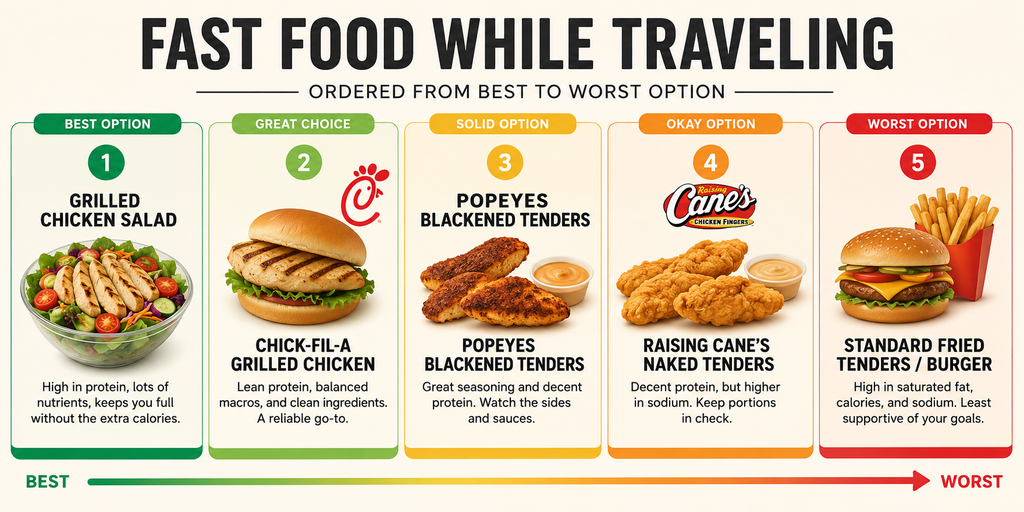
Sometimes the only thing on the road is fast food. Here is the honest ranking.
Genuinely decent: Popeyes blackened tenders are not breaded and not fried in batter, which makes them one of the better fast food protein options available. Chick-fil-A grilled chicken is reliable. A salad with grilled chicken exists at nearly every chain.
Better than the alternative: Raising Cane’s will make their tenders “naked,” meaning unbreaded, on request. Worth knowing: they are still fried, just without the coating, so you are cutting roughly half the calories rather than making it a health food. You have to order in person rather than in the app and they take longer, since they are made fresh.
That distinction matters. Better than a cheeseburger and fries is a real win. Calling it clean would be lying.
A real day of eating on the road
Since I am currently in a bulking phase, here is what an actual travel day looks like for me.
Morning. Two Greek yogurt cups with granola. That is roughly 40g protein and 40g carbs before I have done anything, and it takes no preparation.
Train.
Post workout. A protein shake and dried fruit. Fruit works well after training, and I keep fat lower around workout time.
Midday. One of the sandwiches I packed, or a run out for rotisserie chicken.
Later. A protein bar and another clean meal, or whatever the restaurant situation allows using the ordering rules above.
Nothing there requires a kitchen. Most of it requires a fridge and twenty minutes at a grocery store.
The part nobody wants to hear
Here is where I will be direct, because this is the actual obstacle and it is not logistical.
People who travel occasionally treat every trip as a vacation and take the week off. That works fine if you travel twice a year. The more you travel, the less it works, because at some point travel stops being the exception and becomes your normal life. You cannot grant yourself a permanent exemption from your own diet on the grounds that you are not home.
The rest of it is accountability. It is easier to grab McDonald’s off the highway than to find something better. But there is always something better. If you are getting fast food anyway, you can get the salad with grilled chicken. You can get blackened tenders. You can avoid the fried option and still eat.
That takes maybe two extra minutes. People skip it not because two minutes is expensive, but because taking the better option means admitting it was available, which means admitting the earlier choices were choices.
You have to be honest with yourself that it just takes a little more effort. That is uncomfortable, and it is also the whole thing. We are talking about your body and your health, which are worth two minutes.
The self-honesty is the real skill. Food is just where you practice it this time.

What matters and what does not
Some nuance, since this space rewards obsessing over the wrong variables.
Overrated: the exact macro split on a travel day. Whether you ate at 7pm or 9pm. Whether the chicken was organic. Hitting a perfect number on a trip where you also slept four hours.
Underrated: total protein across the week. Whether you drank enough water. Whether you walked. Whether you made one grocery run instead of zero. Whether you kept your supplements consistent, which I do, identical on the road and at home.
The fundamentals carry it. The details matter once the fundamentals are handled, and on the road they usually are not.
FAQ
How do you eat healthy while traveling without a kitchen? Get a fridge if you can and build around a grocery run. Rotisserie chicken, prepared salads, Greek yogurt cups, and fruit require no cooking at all. If there is no fridge, fill an ice bucket or a clean garbage can with ice, which I have done.
What should I pack to eat healthy on a trip? Real sandwiches for the travel day, protein bars with short ingredient lists, single serving nut packets, protein powder, dried fruit portioned from a bulk bag, and a collapsible cooler bag even if it starts out empty.
How do you order healthy at a restaurant while traveling? Ask the server to have the chef prepare it with no butter or oil. Then pick a lean protein, steamed vegetables, and rice or a baked potato you top yourself. Steakhouses and Mediterranean places make this easiest.
What is the best fast food when you are traveling? Grilled chicken options are the reliable answer. Popeyes blackened tenders are not breaded, Chick-fil-A grilled chicken works, and most chains have a salad with grilled chicken. Raising Cane’s will make tenders unbreaded on request, which cuts roughly half the calories, though they are still fried.
Should you just take the week off from your diet while traveling? If you travel twice a year, that is a reasonable choice. If you travel often, it stops being a week off and starts being how you eat, because travel becomes your normal conditions rather than an exception to them.
Do you need a kitchen to eat well on the road? No, though it helps enough to be worth booking for. A fridge plus one grocery run covers most of it. I book Airbnb or VRBO when a kitchen matters for the trip, and work around it when it does not.
Close
Eating well on the road is not about willpower and it is not about finding a city with good restaurants. It is preparation, one grocery run, one ordering script, and being willing to look slightly harder for the better option.
That option is always there. Whether you take it is the only real question, and you already know the answer before you ask it.

- Best Travel Workout Equipment for a Carry-On - September 1, 2026
- How to Stay Active and Recover While Traveling - September 1, 2026
- Healthy Eating While Traveling: The Complete Nutrition Guide - September 1, 2026