

How to Stay Active and Recover While Traveling
The last trip where I did not train at all was in 2013.
Not because I always find a good gym. Because there is almost always something, and after enough years on the road you stop treating “no gym” as an answer to anything. I have trained in a gym built out of a shed in rural Wyoming. I have trained in a community gym inside a police station in a town of under a thousand people, somewhere between Las Vegas and Santa Fe. Both sold day passes.
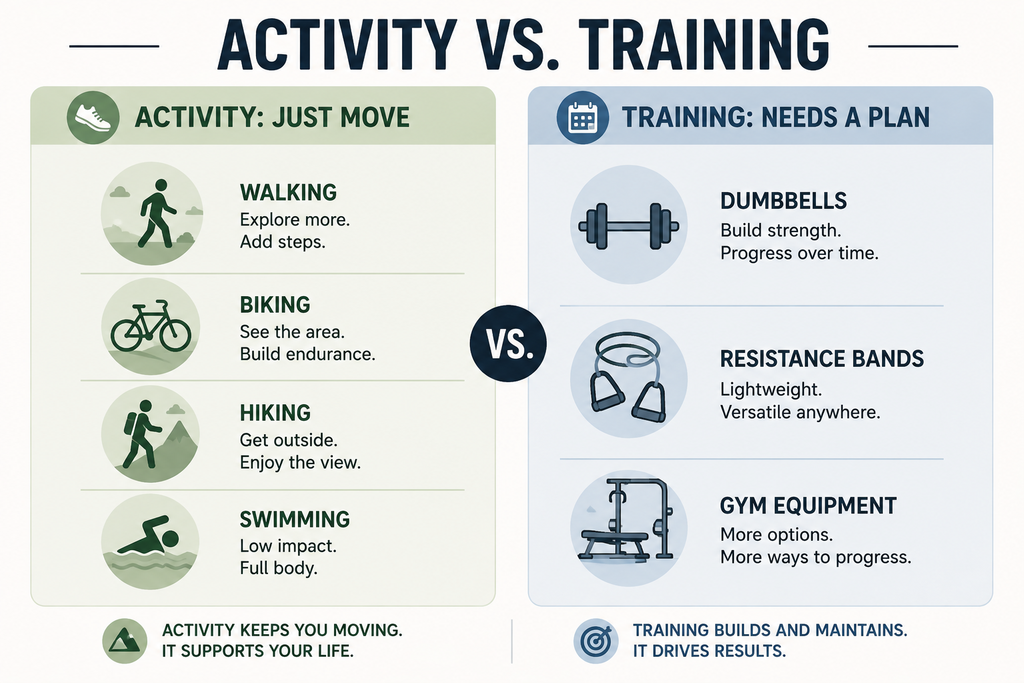
Here is how to stay active while traveling without a gym: separate activity from training. Training needs equipment or a plan. Activity just needs you to move, and it comes from walking instead of driving, renting a bike in a new city, hiking off whatever trailhead the road offers, or swimming in the hotel pool. Then protect your sleep, because that is the piece travel actually breaks and the one that costs you the most when it goes wrong.
Look harder before you conclude there is no gym
Plenty of my trips have had very little opportunity to train. None of them, in over a decade, have had none.
Rural places surprise people. That Wyoming shed gym was real and it had day passes. So did the police station gym in the tiny town between Vegas and Santa Fe. So did the one I found in rural Vermont. Small towns often have a community facility, a school gym with public hours, or one independent place that has been there for twenty years and is not well indexed online.
When there genuinely is nothing, you still have options: outdoors, park benches, bands, and your own bodyweight.
If you want to take a week off, take it. That is a real choice and I am not going to argue with it. What I will push back on is the claim that there was no option, because in thirteen years of looking I have not found the trip where that was true.
What an active day looks like with no workout in it
Sunday is my usual rest day and it still runs about three miles of walking, without calling any of it exercise. Walking to and from where I am going covers it. Same on travel days when I am not training.
The rest of it comes from replacing transport with movement and treating the destination as something to explore rather than sit in.
Walk instead of driving. To the office, to get groceries, to dinner. This is the largest and easiest source of daily movement most people have and it does not feel like anything.
Rent a bike. In a new city this is the best version of active recovery I know. You cover ground, you see the place properly, and you get a couple of hours of easy movement. I have done bike tours in New Orleans, Savannah, Barcelona, and Ireland.
Hike whatever the road gives you. On drives I will pull off at a trailhead and take whatever it is, ten minutes or two hours. Fresh air, sunlight, and a body that has been in a seat for four hours gets to move.
Swim. Most hotels have a pool and almost nobody uses it for this.
Kayak, paddle, walk a park. Anything that gets you outside and moving counts.
The frame that makes this work is exploration rather than exercise. You are not doing cardio, you are seeing the place. The activity is a side effect, and that is exactly why it is sustainable.
Active recovery versus just being busy
Worth drawing this line clearly, because a lot of steps get claimed as recovery that were really just a hard day.
The difference is intent.
On my last trip I took Monday off from training and spent it at Dollywood. That was a planned rest day. I knew I would get an enormous number of steps, I decided in advance that the day would be my recovery, and it was: movement, sunlight, a good time, rotisserie chicken and my own snacks brought in.
A day where you accidentally walked 15,000 steps sprinting between meetings and a delayed flight is not that. Same step count, completely different day. One was chosen. The other happened to you.
Deciding in advance is what turns activity into recovery. Otherwise you are just tired.
Tracking helps more than it should
I track steps on an Apple Watch. It is a small thing that works.
Setting a target, ten, fifteen, or twenty thousand depending on the day, keeps you accountable without requiring an actual workout. On days where training is not happening, the step goal is what stops the day from being nothing.
Use it as a prompt rather than a scoreboard. The number is not the point. Going for the hike is the point, and the number is what reminds you to go.
The Europe flight that wrecked me
Sleep is the hardest part of recovering on the road, especially over long distances, and I have gotten it badly wrong.
About ten years ago I flew to Europe and did not sleep at all on the flight. Not a minute. I landed around 10am local time feeling like a zombie, genuinely wrecked.
I got an early check-in and slept immediately. Woke up feeling worse than when I lay down, which is the same lesson I keep relearning about sleeping through travel fatigue. So I went outside, walked, got blood moving and got some sunlight, and started to come back to myself.
The damage was already done. My sleep pattern was off for the next two or three days. My focus was down, my energy was down, and I was weaker physically and mentally for most of that stretch.
What I do differently now: I prepare for sleep on long flights instead of hoping for it, and I take hydration seriously the whole way. That was ten years ago and I travel far more now than I did then. The mistakes were the education.
Sleep across time zones
Two different problems, and they get opposite answers.
Short domestic trips: stay on your home schedule. East Coast to West Coast for a few days means waking earlier and sleeping earlier by local clock. You avoid shifting your rhythm and then having to shift it back.
Long international travel: adapt as fast as you can. Multiple time zones and a longer stay mean you have to get onto local time, and dragging it out makes it worse.
Some tactics that help going east:
Take the overnight flight. The clock is pushing forward anyway. An overnight arrival puts you on the ground in the morning or daytime, which is what you want.
Get onto the local schedule that first night, even if the first night is rough. One bad night is cheaper than four half-adjusted ones.
Shift gradually before you leave, if your life allows it. Moving your bedtime by an hour for a few days ahead of the trip takes some of the edge off. This is easier for some people than others, and it depends entirely on whether your mornings are yours to control. If they are not, skip this one and lean on the other two.
What to do the moment you land
Movement, light, and water, in that order.
Walk. Get outside if there is any daylight left. Drink more than you think you need. All three of those do more for how you feel tomorrow than lying down does, and the Europe trip is my evidence: the nap made it worse, the walk started fixing it.
If you can train that day, train. It is often the fastest reset available.
The rest of the recovery picture
Beyond activity and sleep, recovery on the road runs on the ordinary things: hydration, food close to your normal diet, soft tissue work if you carry something for it, and knowing where to find a massage chair when you have been in a car for eight hours.
Those deserve more room than a paragraph, and they have it in the travel recovery guide. The short version: nothing beats sleep, water, food, and walking, and no piece of gear substitutes for getting those four right.
FAQ
How do you stay active while traveling without a gym? Replace transport with movement and use the destination. Walk instead of driving, rent a bike, take whatever trailhead the road offers, swim in the hotel pool. Set a step target so days without a workout still have movement in them.
Is walking enough to stay in shape while traveling? It is enough to stay active and recover well, and on a trip with no training options it is a legitimate substitute for a few days. It does not replace resistance training over a longer stretch, but it keeps you moving and it protects the habit.
What counts as active recovery on a trip? Movement you chose in advance as your recovery for that day. A planned rest day spent hiking, biking, or walking a city counts. Accidentally hitting a high step count during a stressful travel day does not, because the intent was not there.
How do you fix your sleep after a long international flight? Get onto local time immediately rather than gradually. Take the overnight flight when heading east so you land in daylight, then walk, get sunlight, and hydrate. Sleeping the moment you land tends to make the first day worse.
Should you adjust to local time on a short trip? Usually not. For a few days domestically, staying on your home schedule keeps your rhythm intact and avoids resetting twice. Longer international trips are the opposite and require adapting quickly.
Can you really find a gym in a rural area? More often than you would expect. I have used a gym built out of a shed in rural Wyoming and a community gym inside a police station in a town of under a thousand people. Small towns frequently have something with a day pass, and it is usually not well indexed online, so ask locally.
Close
Recovery on the road is not a separate discipline. It is the same decision you already make about training, applied to the days you are not training.
Move. Get outside. Sleep as well as the trip allows. Then when a real gym shows up, or a shed with weights in it, you are ready to use it.
- Best Travel Workout Equipment for a Carry-On - September 1, 2026
- How to Stay Active and Recover While Traveling - September 1, 2026
- Healthy Eating While Traveling: The Complete Nutrition Guide - September 1, 2026