
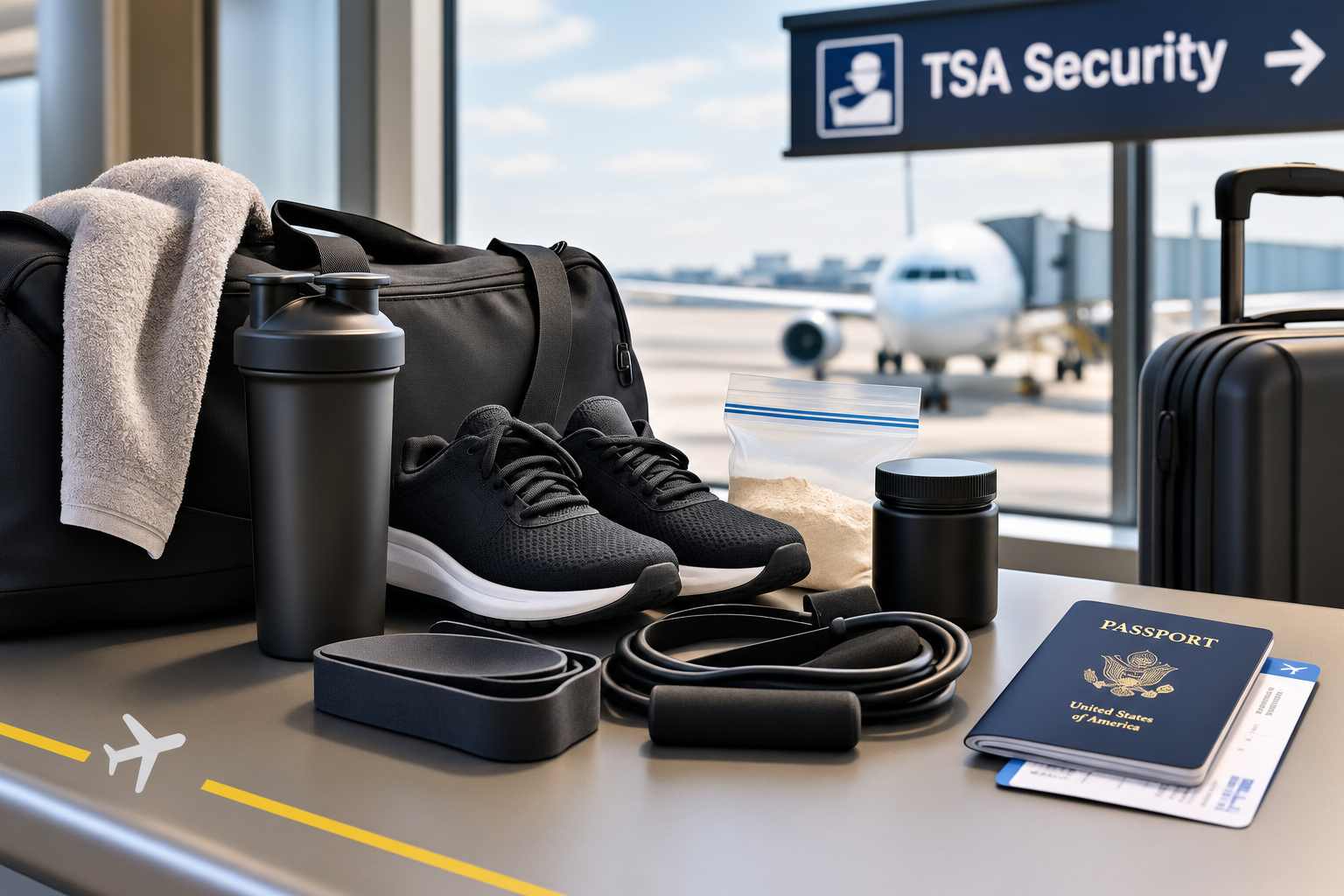
What You Can Bring on a Plane: A Lifter’s Guide to TSA

- How Much Is a Gym Day Pass? Real Prices I Have Paid - October 26, 2026
- What You Can Bring on a Plane: A Lifter’s Guide to TSA - September 24, 2026
- Best Travel Workout Equipment for a Carry-On - September 1, 2026
In years of flying with protein, creatine, pill organizers, resistance bands, suspension straps, and a foam roller, I have been stopped plenty of times.
I have never once been told I could not bring something.
That gap between “stopped” and “denied” is the whole thing. Almost everything a lifter travels with is permitted in both carry-on and checked luggage. The only question is whether a screener looks twice, and there is one principle that predicts it.
The principle: volume per container
It is not how much you are carrying. It is how much is in any one container.
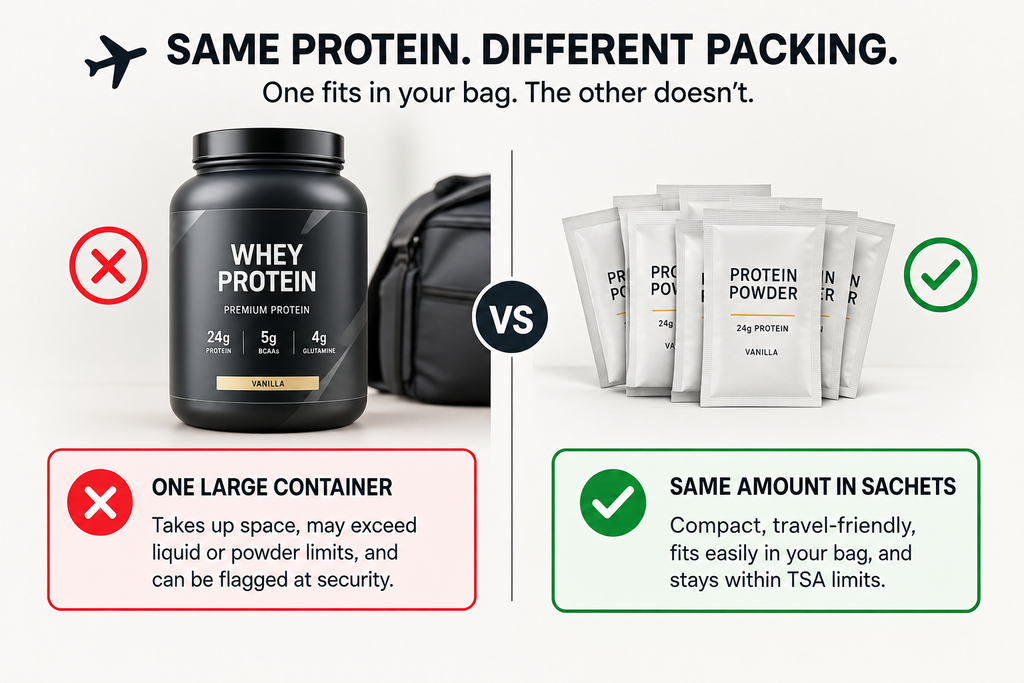
A tub of protein or a gallon zip bag full of powder is very likely to get pulled. A dozen individual sachets containing the same total amount usually goes straight through.
Same substance, same quantity, completely different experience at the checkpoint. The X-ray is reading a single dense mass, and a big one is what gets a second look.
Once you understand that, packing decisions get easy. Break things into smaller containers, favor sealed single serve packaging, and you will rarely be stopped at all.
The same logic applies to gear. One or two bands and a foam roller barely register. A full set of suspension straps with large buckles is more likely to get attention, because hardware looks like hardware.
Powders
Allowed in carry-on and checked. This is the category most likely to get pulled.
US screening guidance flags powder-like substances over 12 ounces in carry-on bags for additional screening. That is a trigger for a swab test, not a ban and not a quantity limit.
Most likely to be stopped: a full tub, or loose powder in a gallon zip bag. If that is what you are carrying, build in a few extra minutes at security.
Least likely to be stopped: individual sachets and small containers.
Protein and creatine each have their own specifics, covered in their own guides.
Pills and vitamins
Allowed, and rarely an issue. I have never been stopped over pills or vitamins.
Loose capsules in a weekly or monthly organizer are extremely common and screeners see them constantly. There is no requirement to keep everything in original bottles for domestic flights.
If you want to be careful, keep the original packaging for anything unusual, or photograph the labels before you travel so you can identify something quickly if asked.
Liquids
This is the one real restriction, and it catches people.
Premade protein shakes and protein shots are liquids. They follow the standard carry-on liquid limits, no matter how much they feel like food.
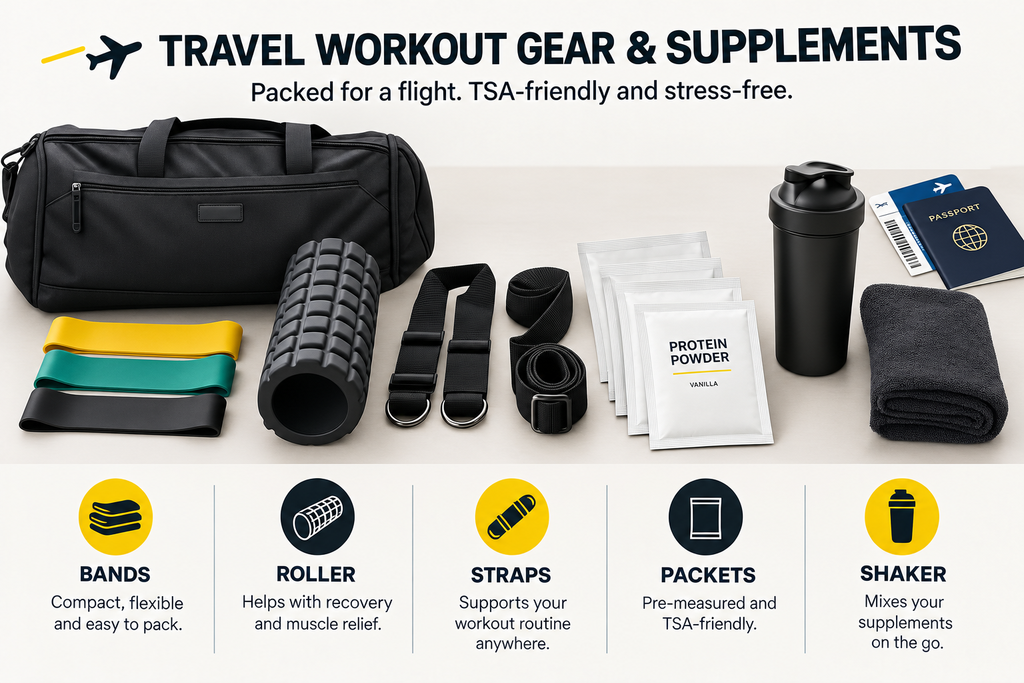
The workaround: carry sachets through security and mix them into a water bottle you fill on the other side. Same drink, no rule broken, and you have water for the flight.
Gear
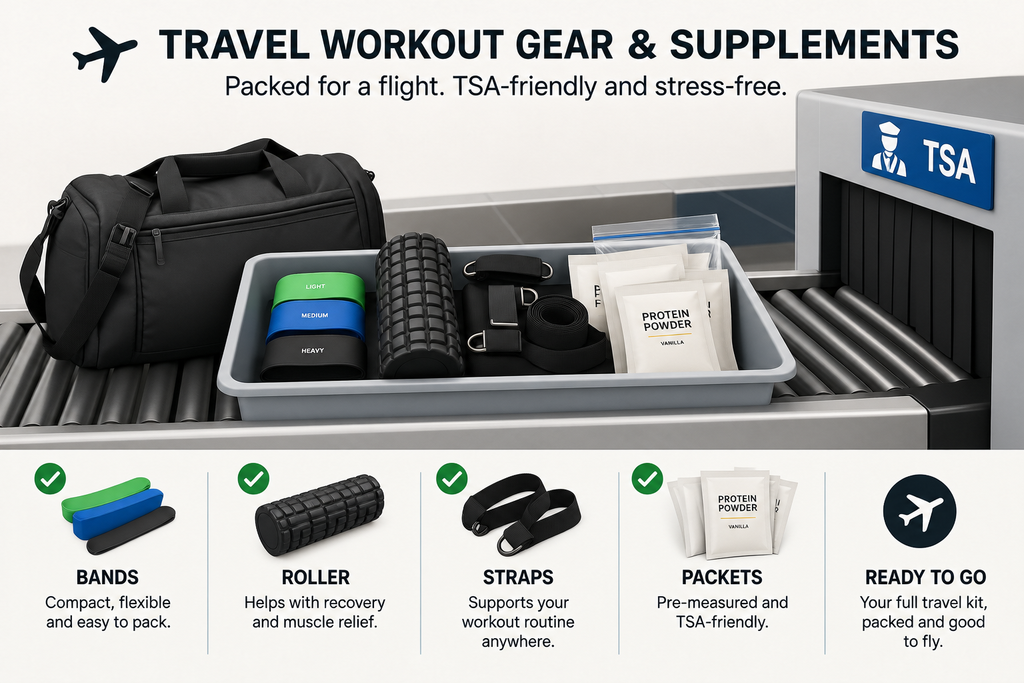
Bands, jump ropes, foam rollers, and suspension trainers are all allowed in carry-on and checked bags.
I have been stopped over gear a couple of times and never had anything taken.
- One or two bands and a foam roller: almost never stopped.
- A jump rope and a band: almost never stopped.
- Full suspension straps: more likely to get a look, because the large buckles read as hardware on an X-ray. Still allowed, still never confiscated in my experience.
If you want the smoothest possible trip through security, that is an argument for the minimal kit rather than the full one. Not a strong argument, but a real one.
What actually happens when you get stopped
The sequence never varies.
They pull your bag off the belt. They open it and locate the item. They swab the container and run the swab through a machine that tests for explosive residue. It comes back clean. They repack and hand it back.
Two or three minutes. Nobody is accusing you of anything, and the screener has done this a hundred times today.
The only real cost is time, which is why the useful advice is not “avoid getting stopped” but “leave a few extra minutes.” If you are carrying a tub of protein and you arrive at security with eight minutes to spare, that is the actual problem, not the protein.
Carry-on or checked?
Both work for everything discussed here except liquids.
Checked means zero screening interaction for you. Nothing gets pulled in front of you, because you are not there.
Carry-on means you still have your supplements and gear if a checked bag does not arrive, which is the scenario that actually ruins a trip.
I usually carry on and accept the occasional swab. If checkpoint interactions bother you, check the powders and carry everything else.
Flying internationally
I have never had a problem bringing supplements or gear into another country, including across Europe.
That is my experience rather than a guarantee. Rules on supplements and specific ingredients vary by country, and enforcement varies more than the rules do. Two minutes of checking before you pack is worth it for an unfamiliar destination.
Keep original labeled packaging where you can. At a border the question is what the substance is, not whether it is explosive, so a label answers it instantly.
The short version
- Powders, pills, and gear are allowed in carry-on and checked luggage
- Volume per container decides whether you get stopped
- Sealed single serve packets go through easiest
- Liquids are the only genuine restriction
- Getting stopped costs you two or three minutes, not your supplements
- Build in the extra time and none of it matters
FAQ
Can you bring supplements on a plane?
Yes, in both carry-on and checked bags. Powders over 12 ounces in a carry-on may get additional screening in the US, which means a swab test lasting a couple of minutes. Pills and capsules rarely draw attention at all.
Will TSA take my protein powder or creatine?
It has not happened to me in many years of flying with both. Large containers get swabbed and returned. The realistic cost is time, not your supplements.
Do supplements need to be in original packaging?
Not for domestic flights. Loose capsules in a pill organizer are common and rarely questioned. Original labeled packaging is more useful for international travel, where the question is what something is.
Can you bring resistance bands and a foam roller on a plane?
Yes, both in carry-on and checked luggage. Small gear is rarely noticed. Suspension straps with large buckles are more likely to get a second look, though they are still permitted.
Can you bring protein shakes through security?
Premade shakes and protein shots are liquids and follow standard carry-on liquid limits. Bring sachets instead and mix them after the checkpoint.
How do you avoid getting stopped by TSA with supplements?
Use smaller containers and sealed single serve packets rather than one large tub or bag. The same total quantity split across small packages attracts far less attention than a single dense mass.
How much extra time should you allow at security?
A few minutes if you are carrying powders in a large container. The screening itself is short, but it only feels like a problem if you arrived with no margin.
Close
Nearly everything in a lifter’s bag is allowed on a plane. The only variable you control is how it is packaged, and smaller containers mean fewer stops.
Pack sachets where you can, keep the tub in checked luggage if you would rather not have the conversation, and leave a few extra minutes. That is the entire strategy.