


How to Stay Fit While Traveling: The Complete Guide
I once trained in a Target parking lot halfway through a long drive. Pull ups off the bar across the middle of a car corral, push ups on the curb, dips off a bench, step ups onto the same bench, jogging laps between rounds. It took about 25 minutes and nobody said a word to me.
Here is how to stay fit while traveling: stop trying to run your normal program on the road, and start running a flexible one that bends to whatever each day gives you. Train on travel days when you know the next few will be thin. Keep one small piece of equipment in your bag. Accept that some sessions will be short and strange. The people who stay in shape while traveling are not the ones with better hotels. They are the ones who kept the standard and dropped the format.
That is the whole thing. The rest of this is the how.
I used to take the week off
For a long time I did what most people do. Trip on the calendar, week off from training, pick it back up when I got home. That worked fine when travel was occasional.
Then travel stopped being occasional. Once you are on the road most of the year, “I will start again when I get back” stops being a plan and turns into a slow exit. If you take the week off every time you travel, and you travel constantly, you do not train.
So I changed the rule. For roughly the last five years I have not gone more than a day without doing something physical. Not more than a day. That does not mean five hard sessions a week every week. It means that on any given day there is something, and the definition of “something” is wide on purpose: calisthenics, bands, suspension training, finding a gym, making a gym out of whatever is around, a long hike, a serious walk, renting or borrowing a bicycle for an afternoon.
I am 39 now and in the best shape I have ever been in. That is not from a perfect setup. I have almost never had a perfect setup. It is from being consistent in imperfect ones.
The short version of my background: I was an active kid until around fifth or sixth grade, then some health issues hit and I gained a lot of weight. I carried it until about tenth or eleventh grade, when I got moving again and lost it. I was not a fitness person at that point, I just got thinner and did not think much about it. The actual training started around 20 or 21, when I decided I wanted to build muscle and get strong instead of just be smaller. Twenty years of refining it since then, and the last several of those on the road.
So none of what follows is theory. It is what I worked out because I had to.
What a real travel week actually looks like
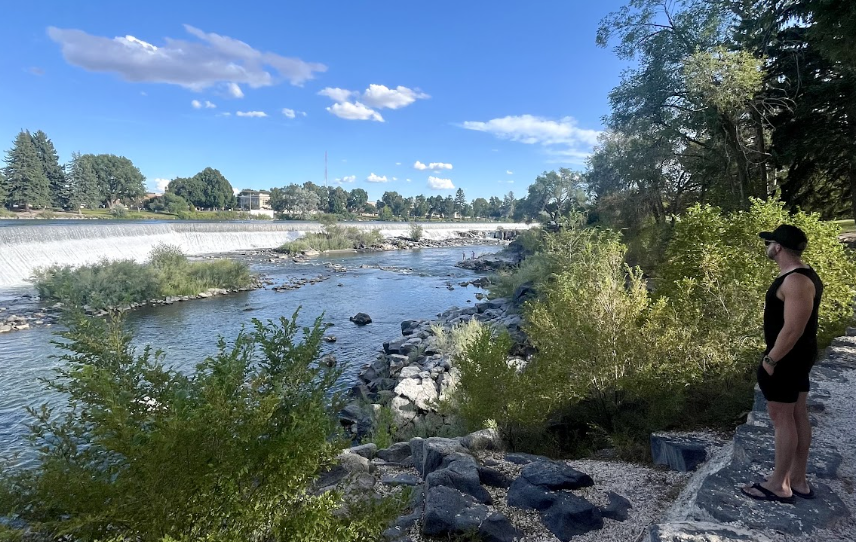
I just got back from six days in Pigeon Forge. This was a vacation, not a work trip, and I still trained every day I planned to. Here is the actual week, unedited.
Sunday. Drive day, Atlanta to Pigeon Forge. I stopped at a Planet Fitness roughly halfway and trained there. Not because I felt like it. Because I had already looked ahead and knew the mountains would be thin on gym options once I arrived.
Monday. Dollywood. This was my planned rest day, and it was still an enormous amount of walking. Rest day on paper, very active day in reality.
Tuesday. Early morning on the balcony of the rental. TRX straps and bands, fast pace, full body. Rows, presses, curls, minimal rest between sets. In and out before anyone else was awake.
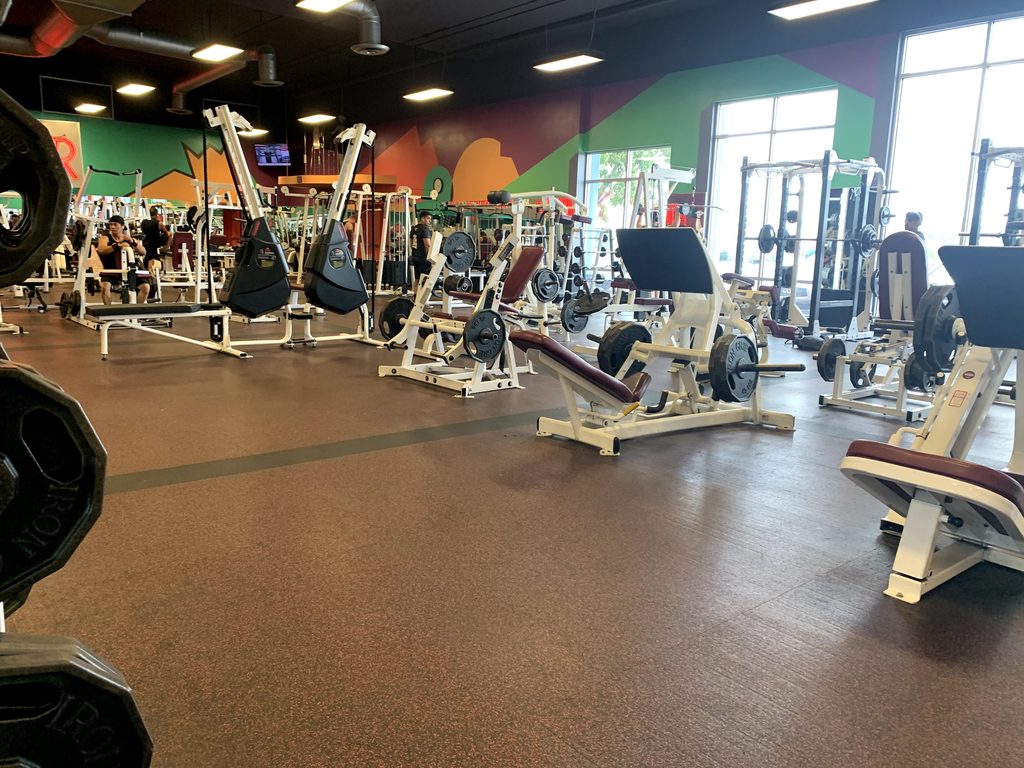
Wednesday. Found a local gym near Dollywood, Elite Fit Labs, under new ownership. Bought a day pass and put in a real leg session. This was the hardest training of the trip and it happened on vacation, in a town I do not live in, in a gym I had never seen before.
Thursday. On the road again for a long stretch. Same play as Sunday, dropped into a Planet Fitness partway through the drive.
Friday. Home and back into my typical workout for Friday at my home gym. I was a bit tired and increased my rest times just a touch but the slow tempo really allowed me to connect well.
Saturday. Fully normalized and had a heavy training session. My back was cooked, and I was ready for my Sunday rest day.
Six days. One planned rest day. Four different training environments: a chain gym, a rental balcony, an independent gym I had never been to, and a highway stop. Nothing about that week was ideal. All of it counted.
Train before the hard part, not after it
This is the single move that changed travel for me, and almost nobody talks about it.
Most people treat the travel day as a write-off. You drive or fly, you arrive tired, you tell yourself you will start fresh tomorrow. Then tomorrow has a scheduling problem, and now you are two days in with nothing.
Flip it. Before the trip, spend five minutes looking at where you are actually going. Search the destination for gyms. Look at the hotel or rental listing to see if there is a fitness room, and look at the photos honestly, because “fitness center” often means two treadmills and a broken cable machine. If the back half of the trip looks thin, train on the travel day.
That is why I stopped at a Planet Fitness halfway to Pigeon Forge. I knew what was waiting for me. Breaking a long drive with a 45 minute session also does more for how you feel at the other end than the extra 45 minutes of driving ever would.
Scouting before you leave takes five minutes and removes most of the decisions you would otherwise have to make while tired.
The five options, in order
When you land somewhere, you have a ladder. Work down it until something is available.
- A real gym. Day passes exist almost everywhere. Independent gyms will usually sell you one, and it is often cheaper than people expect. This is how I got a full leg day in near Dollywood. If you travel constantly, a membership at a chain with wide coverage is worth pricing out.
- The hotel gym. Frequently mediocre, occasionally excellent, almost always usable if you adjust the plan to the equipment instead of forcing your plan onto it.
- Your own equipment. Bands and a suspension trainer weigh almost nothing and fit in any bag. That is what the balcony session was. I use TRX, and I also travel with a GoFit strap trainer sometimes, depending on what I have with me. Either one plus a set of bands covers a genuine full body workout.
- Bodyweight in the room. Calisthenics work. You can be extremely crafty in a hotel room with nothing at all. And you do not need gym clothes for this. Train in your underwear. Nobody is there, you are not packing a second outfit, and you are not putting sweaty clothes back in a suitcase for three days. Whatever you do sweat through, wash it in the sink and hang it to dry overnight. One item of clothing covers an entire trip that way. One less thing to pack, one less excuse to reach for.
- Whatever is outside. Parking lots, stairwells, park benches, playgrounds. And when none of that works, the day still counts if you go for a real hike, walk a serious distance, or rent or borrow a bicycle for a couple of hours.
Most people stop at option two, find it lacking, and quit. The ladder goes further than that.
Split or circuit: the one decision that matters
Once you know what equipment you have, you only have one real choice to make.
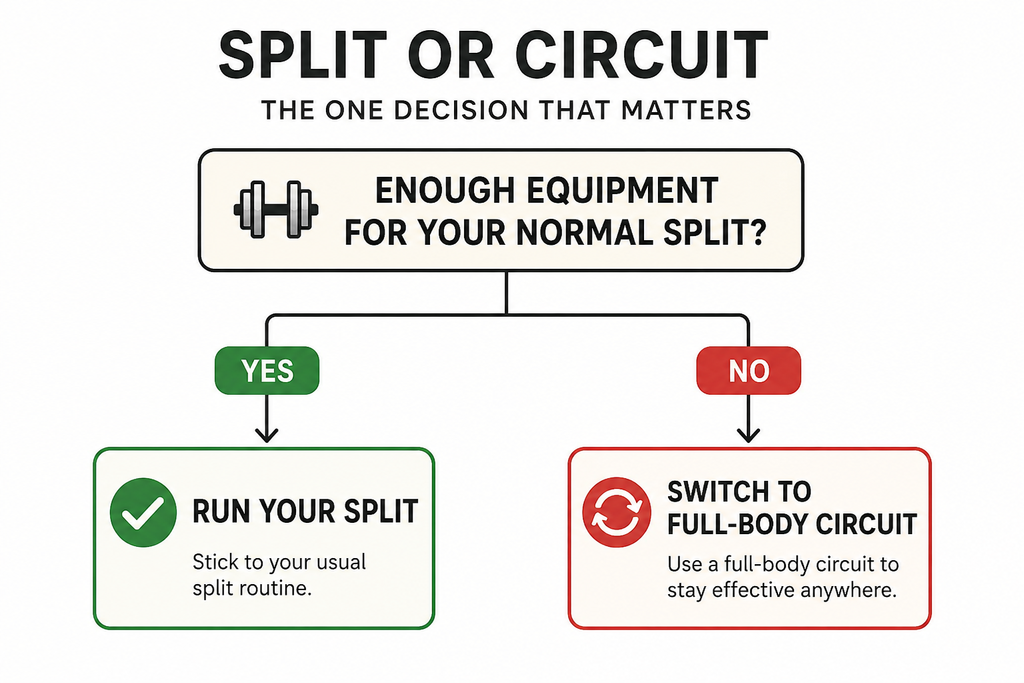
If there is enough there to stay on your normal split, stay on it. Walk in, run your chest day or your leg day, go home. Nothing about travel requires you to abandon a program that is working.
If there is not enough, switch to a circuit. This is the part people get wrong. They walk into a hotel gym with 25 pound dumbbells, try to force their chest day onto it, get nothing out of it, and conclude the gym was useless. The gym was not useless. The plan was wrong for it.
When you do not have enough resistance to drive real growth in one muscle group, stop trying. Do a little of everything instead. Full body, moving between exercises, moderate effort. You cover the whole body, you do not wreck yourself, and you walk back into your normal routine the moment you have real equipment again without needing a recovery day first.
That is the actual purpose of a travel circuit. It maintains. It is not trying to be your best session of the month, and it does not need to be.
The Target parking lot workout
Since it started this article, here is the actual session.
I was on a long drive and needed to move. I pulled into a Target, walked the lot, and inventoried what was there. A car corral with a horizontal bar across the middle. A curb. A bench. Open pavement.
That is a gym.
- Pull ups and chin ups off the car corral bar. If the bar is too high or you cannot do them yet, get under it and do inverted rows instead. Same muscles, easier entry point.
- Push ups on the curb. Hands elevated makes them easier, feet elevated makes them harder. Pick your level.
- Bench dips off the bench.
- Step ups onto the bench.
- Bodyweight squats and split squats with a foot up on the bench.
- Jogging laps around the lot between rounds.
- Faux jump rope, meaning you jump in place and move your hands like you are turning a rope. Looks ridiculous. Works fine.
Circuit it. Move through the list, jog, repeat. Three or four rounds and you are done in about 25 minutes.
For context, a normal session in my home gym runs 40 to 60 minutes. The parking lot version was about half that and it was not as good. It was also not zero, and a 25 minute workout beats a zero minute workout, forever and always.
The point is not that everyone should train at Target. The point is that “there was no gym” is a description of a building, not a description of your options.
How to train in an airport during a long delay
I have had the delays. Here is what I actually do.
Walk. Atlanta has the plane train, and you can also walk from any terminal to any other terminal. Skip the train and walk it. A single lap of a major airport is a serious amount of steps, and you are going to be sitting for the next several hours anyway.
Use the seats. Find a quiet corner near an empty gate. Airport seating is a bench. Bench dips off the seat, push ups with hands on the seat, split squats with your back foot up on it, bodyweight squats. Using the seat instead of the floor takes up less space and draws less attention, which matters more than you would think when you are trying not to make a scene at gate B14.
Find a 24 hour gym. A lot of Planet Fitness locations run 24 hours in major cities. Some independent gyms have after hours access. If you are landing at 1am and staying somewhere with no fitness room, this is worth two minutes of searching before you get in the car.
Nobody cares what you are doing. Everyone in an airport is bored, uncomfortable, and looking at their phone.
The energy problem is real, and it is solvable
Let me be straight about this one, because “just push through it” is not useful advice.
Travel fatigue is real. Bad sleep, dehydration, long sits, time zones, none of that is in your head. The tiredness is legitimate.
It is also usually not the actual obstacle. Most of the time the tiredness is a reason and the missed workout is a decision, and those are two different things.
What I do: travel with a small sachet of something. A single serving preworkout, an energy stick, whatever fits your tolerance. Tiny form factor, lives in the bag permanently, so I always have it. If it is early enough in the day, a coffee does the same job.
That is it. It is not a hack. It is removing one small obstacle so the decision gets easier.
Rest days, honestly
Take them. Plan them.
My rest day was Dollywood, which meant a huge number of steps and a physically demanding day. That is what a good travel rest day looks like. You are not training, but you are not horizontal either.
There is a difference between a planned rest day and a day you lost. A planned rest day is part of the program. A lost day is one where you meant to train and did not, and then told yourself afterward that it was a rest day. You know which one you are having. Do not lie to yourself about it. Own it, log it, and go again tomorrow.
The floor: what still counts
Every trip has a day where everything goes sideways. Here is the standard I hold on that day.
Something happens. Ten minutes of bodyweight in the room. A hard walk. A short circuit off a chair. It does not have to be productive in a training sense. It has to keep the identity intact.
The workout you get on the worst day is worth very little physically. It is worth a great deal in every other way, because the streak of “I am someone who trains” is the thing that carries you to the next real session. Break that and the next trip is harder. Keep it and the next trip is easier.
Too tired, no gym, no equipment, no clothes, no time. Every one of those has been true for me on the road, several of them at once. Every one of them also has an answer, and you have now read most of them. None of them is a reason to become someone who does not train. They are reasons to train differently for a few days.
That is the part that bleeds into the rest of life. The reason this matters is not the physique. It is that you practiced doing what you said you would do under conditions that gave you a perfect excuse not to. That skill does not stay in the gym.
FAQ
How do you stay fit while traveling without a gym?
Use bands or a suspension trainer, which fit in any bag, or go pure bodyweight. A full body circuit of push ups, rows, squats, split squats, and dips off a chair covers everything a hotel room needs to cover. Outside, benches, stairs, and pull up height bars turn a parking lot into equipment.
How many days a week should I train while traveling?
Match your usual frequency if you can, and drop to a floor of two or three real sessions if the trip is dense. On my last six day trip I trained five days and took one planned rest day. Consistency across the trip matters more than any single session.
Can you get a day pass at a gym while traveling?
Yes, almost everywhere, and it is usually cheaper than people expect. Independent gyms will sell one at the desk, and many have tiered pricing for longer stays. At the gym I used near Dollywood it was $20 for a single day, $40 for three days, or $60 for the week. If you are somewhere for more than two days, ask about the multi-day rate before you pay per visit. (Prices as of [month/year], always confirm at the desk.)
Is it worth working out on a travel day?
Often it is the smartest day to train. If you know your destination will have limited options, break the drive or the layover with a session. You arrive having already trained, and you are not carrying a deficit into the trip.
Should I take a week off training on vacation?
Only if you actually want to. I trained on vacation last week and it cost me nothing in enjoyment. Early morning sessions and one gym day pass fit around a full itinerary without taking anything away from the trip.
What should I pack to work out while traveling?
A set of resistance bands and a suspension trainer, TRX or similar. Both are light, both pack flat, and together they cover pushing, pulling, and lower body. Add a single serving of preworkout or an energy stick for the hard mornings.
Close
The road is going to hand you a legitimate excuse on most trips. Bad sleep, no gym, a schedule that collapses. You get to decide in advance that none of it changes what you do, only how you do it.
I am in the best shape of my life right now, and I have spent the last several years training in hotel rooms, rental balconies, chain gyms in towns I was passing through, and at least one Target parking lot. Almost none of it was ideal. That turned out not to matter. What mattered was that it kept happening.
Keep the standard. Change the format. That is the whole system.

- Best Travel Workout Equipment for a Carry-On - September 1, 2026
- How to Stay Active and Recover While Traveling - September 1, 2026
- Healthy Eating While Traveling: The Complete Nutrition Guide - September 1, 2026